IPTV Headend: Equipment, Encoders and Costs From $495
Quick answer: An IPTV headend receives your source feeds, encodes them into IP streams and prepares them for a managed network or a delivery platform. Small headends can run on single-channel encoders from $495 each. Larger ones use a multi-channel rack encoder from $2,990. The headend also needs switching, stream management and monitoring, so encoder count alone does not define a complete system.
What an IPTV headend includes
- Sources: cameras, set-top boxes, media players, switchers, via HDMI or SDI.
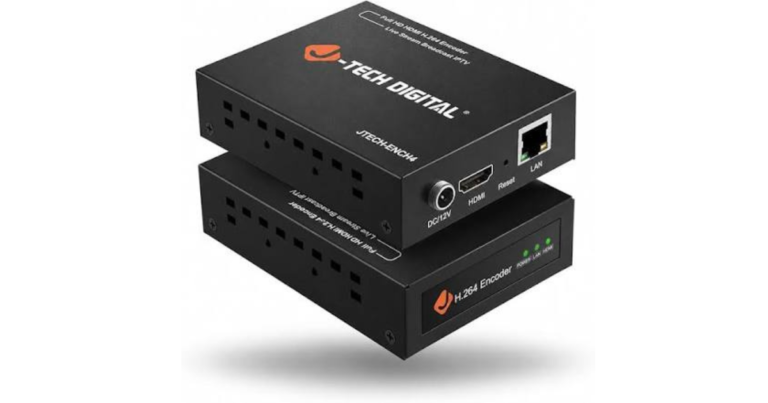
- Encoders: turn each source into an IP stream. This is the core of the headend.
- Network: a switch with enough capacity, and multicast support if you use it.
- Delivery: direct unicast or multicast, or a packager and origin server for HLS.
- Playback endpoints: TVs, set-top boxes, apps or decoders.
- Monitoring: checks for picture and audio at the receiving end, not just the encoder status light.
IPTV headend equipment by size (PVI examples)
These examples come from the PVI store at the time of writing. Prices and specifications can change.
| Headend size | Example PVI equipment | Listed price |
|---|---|---|
| 1 to 3 HDMI sources | VeCASTER HD H.264, one per source | $495 each |
| 1 to 3 HDMI sources with HEVC | VeCASTER HD HEVC, one per source | $895 each |
| 4 to 16 HDMI sources | VeCODER ULTRA HD H.264, 4 to 16 channels | From $2,990 |
| 2 to 8 sources in 4K | VeCODER ULTRA 4K, 2 to 8 channels | From $3,590 |
| 4 SDI sources | VeCODER ULTRA-4 SDI, 4 x 3G-SDI | $5,990 |
| 1 SDI source | VeCASTER HD SDI HEVC | $1,395 |
Three single-channel VeCASTER HD H.264 units come to $1,485 before rack hardware. PVI also lists a rack bar kit for $149 that mounts up to 15 VeCASTER encoders in 5RU. See the VeCASTER streaming encoder and VeCODER multi-channel encoder guides.
Start with a source schedule
Build a list of simultaneous sources rather than a list of screens. Record the input type, resolution, audio, captions, rights and hours of operation for each. Decide which feeds need redundancy and which can share a backup. This tells you whether compact individual encoders or a multi-input chassis is more practical. For HDMI sources see the HDMI IPTV encoder guide, and for SDI sources the SDI IPTV encoder guide.
Decide how streams leave the headend
A local network may use multicast, while viewers outside the building usually need HLS or another path. Match the encoder protocol to the receiver, and expect a separate packager in some designs. See the multicast encoder and HLS encoder guides.
Operate it as infrastructure
- Document channel names, IP addressing, access controls and change procedures.
- Monitor picture and audio at the receiving end.
- Reserve switch capacity and rack space for future feeds.
- Plan a backup for any feed that matters.
Specific settings: a hotel needs per-room delivery (see hotel IPTV encoder), and a school or campus has its own needs (see IPTV encoder for education). To size the bandwidth, use the arithmetic in the 8 channel encoder and 4 channel encoder guides.
Frequently asked questions
What is an IPTV headend?
It is the part of an IPTV system where source feeds are received, encoded into IP streams and prepared for delivery to a network. It includes encoders, switching, stream management and monitoring.
What equipment does an IPTV headend need?
At minimum, encoders for your sources, a network switch with enough capacity, a way to deliver streams to players, and monitoring. Larger systems add packaging, origin servers and redundancy.
How much does IPTV headend equipment cost?
It depends on source count and format. On the PVI store in October 2026, a single HDMI encoder is listed from $495, a multi-channel HDMI rack encoder from $2,990, and a four-channel SDI unit at $5,990.
Is a headend encoder the same as a streaming server?
Not always. Some encoders include a built-in server for unicast and multicast, while larger systems use separate origin, packaging and distribution components.
How many channels should a headend have?
Count simultaneous authorized sources, then add realistic spare capacity and redundancy needs.
Does a headend supply TV channels?
No. It encodes the sources you connect. You are responsible for having the rights to every feed you distribute.
For the basic difference between an encoder and a playback device, read our IPTV encoder box guide.